

Most contractors who’ve been burned by a home service SEO agency never asked the right questions upfront. These seven will tell you everything you need to know — including what an agency is trying to hide.
You’ve probably been pitched by at least three SEO agencies in the last six months. Maybe more. They all sound roughly the same: top rankings, more calls, proven results, proprietary process, no long-term contracts (until you read the fine print).
The problem isn’t that there are bad SEO agencies. The problem is that bad home service SEO agencies have learned to say exactly what good ones say. The pitch sounds identical. The deliverables look similar on paper. And by the time you figure out nothing is working, you’ve already spent $15,000 and six months you’ll never get back. Knowing the right questions to ask an SEO agency before you sign is the only real filter. If you want to see the full list of common SEO mistakes home service companies make, that’s a good place to start before you even pick up the phone.
These seven questions cut through the pitch. Ask them before you sign anything. The answers — and the non-answers — will tell you exactly what you’re dealing with. And if you’re trying to understand what a fair investment looks like before the conversation even starts, our home service SEO pricing guide lays it out without the sales spin.
1 Can You Show Me Every Link You’ve Built — Domain, DR, and Placement URL?
Link building is one of the highest-leverage SEO activities and one of the easiest to fake. An agency can tell you they “built 40 links last month” and deliver 40 low-quality directory submissions worth almost nothing — or worse, links from private blog networks that put your site at risk of a Google penalty.
A legitimate agency has nothing to hide. Every link they build is something they’d be proud to show you: the referring domain, its Domain Rating, the anchor text used, and the URL of the page where the link lives. You should be able to pull up that page in a browser and see your link sitting there in real editorial content.
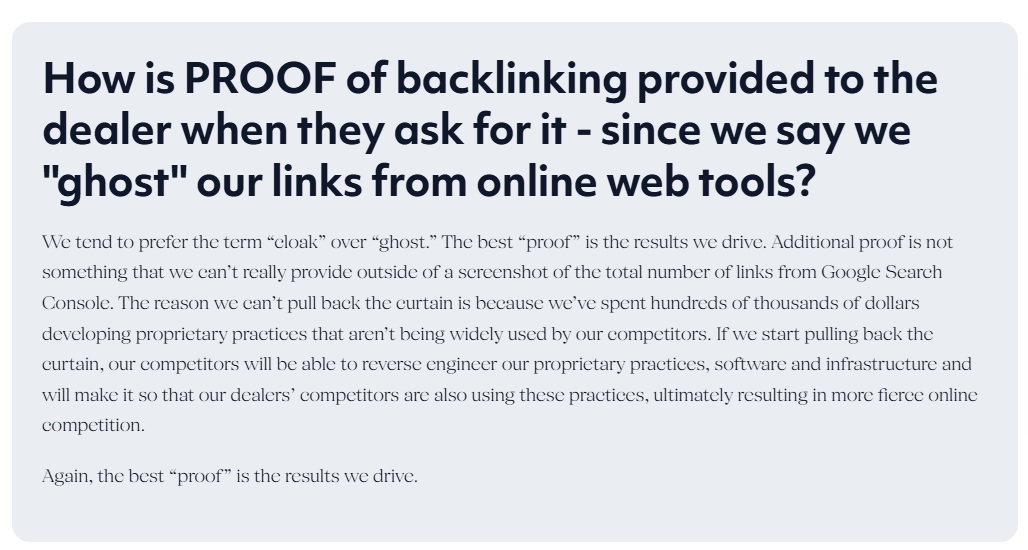
Why this question matters: Some agencies actively “cloak” or hide their link building from third-party tools, framing it as protecting “proprietary methodology.” If a link building practice can’t survive scrutiny from a paying client, it probably can’t survive a Google manual review either. And when Google penalizes a site for manipulative link building, the penalty lands on your domain — not the agency’s. Legitimate link building — citations, directory listings, editorial placements — doesn’t need to be hidden from anyone.
“Absolutely — here’s our link report from last month. Every placement is listed with the domain, DR, anchor text, and live URL. You can verify each one in Ahrefs yourself.”
“We can’t share the specifics because it’s proprietary. The best proof is the results we drive.” — If they can’t show you what they built on your behalf, you don’t own the strategy. You’re renting blind faith.
2 Would Google Approve of Your Link Building Methods?
This question sounds obvious. Ask it anyway — and watch how they answer.
White hat link building is not a secret. Guest post placements on relevant industry sites, editorial mentions from real publishers, citation building, chamber of commerce listings, local business directories — none of this needs to be hidden. The methodology is openly discussed, Google has publicly stated it values these signals, and any agency doing it this way will tell you exactly what they do. If you want a full grounding in how legitimate local SEO actually works, our complete guide to local SEO for home service businesses covers it from the ground up.
The agencies that deflect this question are usually operating in grey or black hat territory: private blog networks (PBNs), link farms, paid placements on sites that exist purely to sell links, or mass automated directory submission. These tactics can produce short-term ranking gains. They also carry the risk of a Google algorithmic filter or manual action that tanks your rankings overnight.
The thing to understand about penalty risk: The agency loses a client. You lose your online presence, your call volume, potentially your business. The risk is not shared equally. Ask them directly: “If Google penalizes my site for the links you built, what’s your liability?” The answer will be illuminating.
“Yes — we only build links we’d be comfortable showing Google. Here’s our process: editorial outreach to relevant industry and local sites, citation building, and strategic partnerships. Nothing that requires hiding.”
Vague answers about “proprietary infrastructure,” “advanced techniques competitors can’t reverse engineer,” or pivoting immediately to results without addressing the question directly.
3 What Are Your Social Media Posts Actually Designed to Do?
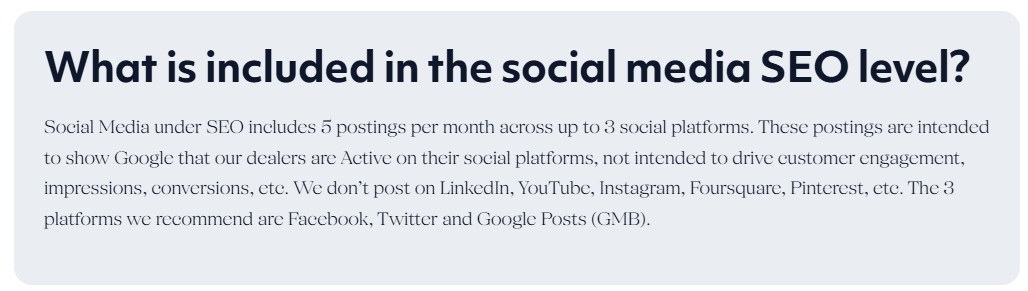
Social media management is a common add-on in home service SEO packages. Ask this question and you’ll quickly discover whether you’re getting a marketing service or an activity signal — posts designed to make your profiles look active to Google, with zero intent to generate engagement, impressions, or calls from actual homeowners.
There is a version of social media management that actually builds your brand, generates referral traffic, and supports your local authority. It requires real strategy, platform-specific content, and measurement against engagement and conversion metrics. It’s also more work to deliver, which is why many agencies don’t do it.
The shortcut version is five generic posts a month, auto-scheduled to Facebook and Twitter, never checked for engagement, never tied to a call or a booked job. If an agency is charging you for social media and can’t show you engagement metrics, reach, or a single lead it generated — ask what exactly you’re paying for. The same standard applies to every SEO deliverable: if it doesn’t connect to revenue, it doesn’t belong on your invoice. Our guide on how to track SEO ROI for service businesses shows you exactly what that measurement looks like in practice.
“Our social posts are designed to drive engagement and direct traffic. Here are the metrics we track: reach, clicks, call button taps, and form submissions originating from social. Last month, our posts drove X clicks to client sites.”
“The posts are mainly to show Google your business is active online.” — If the explicit goal is signaling to an algorithm rather than reaching homeowners, you’re paying for theater.
4 Are You Currently Working With Any of My Direct Competitors?
This one gets glossed over constantly and it shouldn’t. When you hire an SEO agency, you are sharing your keyword strategy, your content gaps, your competitive analysis, your conversion data, and often your GBP insights with that agency. If they’re running the same playbook for your competitor two ZIP codes away, you are directly funding your own competition.
Some agencies will say they don’t work with “direct competitors” but define that loosely enough to mean a competitor in a different city. For local home service SEO, a plumber in Brandon and a plumber in Riverview are absolutely competing — they’re both appearing in the same Map Pack for half the relevant searches in the Tampa Bay metro.
ZIP code exclusivity is the cleanest version of this protection. One contractor per trade per territory, full stop. If the agency can’t commit to that in writing, your investment could be actively working against you the moment they sign your nearest competitor. You can read exactly how our ZIP code exclusivity promise works and what it means for your territory.
“No — and once we take you on, we turn away competitors in your ZIP codes regardless of what they offer. We put that in writing. Here’s how our exclusivity policy works.”
“We work with multiple clients in every market — it’s how we benchmark performance.” — They are selling your competitive landscape to your competition.
5 What Happens to My Rankings If I Cancel?
This is the question that separates agencies building you an asset from agencies building themselves leverage over you.
A legitimate SEO campaign produces rankings, content, backlinks, and GBP authority that belong to you. If you cancel, you keep the rankings you’ve earned. They may decay over time without continued investment, but the foundation is yours. The content lives on your domain. The links point to your site. The GBP you optimized stays optimized. Everything built around a proper service page architecture stays on your site working for you regardless of who manages it going forward.
Some agencies — particularly those using proprietary CMS platforms, private blog network links, or content hosted on agency-controlled infrastructure — build campaigns where the value disappears the moment you stop paying. Your rankings evaporate not because the SEO work stopped, but because the underlying infrastructure was never yours to begin with.
Ask specifically: “Does any content, link, or technical SEO element you build for me exist on infrastructure you control? What happens to it if I cancel?”
“Everything we build lives on your domain and your accounts. The content, the links, the GBP optimization — it’s all yours. If you cancel, you keep what we’ve built. Rankings may require continued maintenance but nothing disappears overnight.”
Vague answers about “transitioning” your account, inability to confirm that all content and links will remain after cancellation, or any mention of proprietary platforms hosting your content.
6 What Metrics Do You Report On — and Which Ones Do You Not Report On?
Every agency reports on the metrics that make their work look good. The question is which metrics they quietly leave out of the monthly report.
Traffic is easy to manufacture — low-quality blog content targeting informational keywords with zero purchase intent can produce impressive traffic charts with zero booked jobs behind them. Impressions are meaningless. Domain Authority is a third-party metric that Moz invented and Google doesn’t use. “Ranking improvements” for keywords nobody searches is technically accurate and completely worthless.
The metrics your business actually runs on are simpler: organic call volume, form submissions from organic traffic, and the revenue those calls produced. If an agency can’t tie their SEO work directly to calls and booked jobs — or won’t — the question is what they’re actually measuring and why they’re not measuring what matters. We’ve written a full breakdown on how to track SEO ROI for service businesses that shows you exactly what a legitimate report looks like.
Ask for a sample report before you sign. If the report is full of traffic graphs, keyword ranking tables for terms you’ve never heard of, and social media post counts — with nothing connecting the activity to actual leads — you have your answer.
“Our monthly report covers keyword rankings for your target terms, Map Pack visibility by ZIP code, organic call volume with source attribution, and new customers acquired from organic. Here’s a sample.”
“Your domain authority increased 8 points and your blog traffic is up 140% month over month.” — Ask how many calls that generated. If they can’t answer, neither metric matters.
7 Can I Talk to a Current Client in My Trade?
This is the simplest question and the one most contractors forget to ask. Any agency confident in their results will connect you with a current client — not a cherry-picked testimonial, not a case study from three years ago, but an active client in your trade who you can call directly and ask whatever you want.
“How long did it take to see results?” “What does the monthly report actually show?” “Have you gotten calls you can directly attribute to the SEO work?” “Would you sign again knowing what you know now?”
An agency that hedges on this — citing privacy, NDA, or “client confidentiality” for basic reference calls — is telling you something. A contractor who is genuinely happy with their SEO results will talk to another contractor for ten minutes. That conversation is worth more than every case study on the agency’s website.
“Absolutely — here are three current clients in the home service space. Call any of them. No prep, no scripts.”
“We have client privacy policies that prevent us from sharing references, but here are some testimonials on our website.” — Testimonials are curated. References are real.
What If the Agency Is Newer With Limited Clients?
Here’s something most contractor guides won’t tell you: a newer agency with limited clients isn’t automatically a red flag. It might actually be your best option.
Smaller, newer agencies are often more agile, more accessible, and genuinely hungry to prove themselves. They haven’t settled into the commoditized deliverable checklists that large shops use to service 300 clients at once. They’re not handing your account to a junior coordinator six weeks after you sign. When you call, the person who built your strategy picks up. That combination of focus and drive is exactly what changes the way contractors think about digital marketing agencies — and it’s worth taking seriously.
That said, limited client history means limited social proof. The right way to bridge that gap isn’t to walk away. It’s to ask better questions and get better contractual protection.
Ask to see their own website’s results. Any SEO agency worth hiring has used SEO on themselves. Ask for a GSC screenshot showing their own keyword rankings, organic traffic growth, and Map Pack visibility for their own agency terms. An agency that can rank their own site has demonstrated the skillset. An agency that can’t — or won’t show you — hasn’t.
Then ask for a written 90-day deliverable guarantee. This is the accountability mechanism that replaces the client reference list. Before you sign, get a document that specifies every deliverable committed for the first 90 days — number of pages optimized, blog posts published, GBP updates completed, citations built, technical fixes resolved — with a timeline attached to each one. The agreement should include three specific protections:
A prorated refund for any deliverable not completed on schedule. If they committed to four blog posts in month one and delivered two, you get a credit for the two they missed — automatically, without you having to fight for it.
A penalty-free cancellation clause that activates if the 90-day deliverables are not met in full. Not “substantially met.” Not “mostly completed.” Met. If the agency misses their own written commitments in the first 90 days, you walk with no fees, no notice period, and no argument.
A deliverable log — a shared document updated monthly showing what was committed, what was delivered, and what’s outstanding. No ambiguity, no “we were working on it,” no retroactive scope changes.
A newer agency that agrees to these terms without hesitation is telling you exactly what kind of partner they’ll be. One that pushes back, hedges, or tries to redefine the deliverables before the ink is dry is also telling you something.
“We’re newer and we own that — here’s our own GSC data showing how we’ve ranked our agency site. And yes, we’ll put every 90-day deliverable in writing with a prorated refund for misses and penalty-free cancellation if we fall short. We’d rather earn your trust than ask for it.”
“SEO takes time and results can’t be guaranteed — we can’t commit to specific deliverable timelines.” — Deliverables are not results. An agency can’t guarantee rankings. They absolutely can guarantee that they’ll publish the four blog posts they told you they’d publish. Conflating the two is a deflection tactic.
✓ The Quick Reference Cheat Sheet
Print this out. Bring it to every agency call.
| Question | Red Flag Answer | What It Means |
|---|---|---|
| Show me every link you’ve built | “It’s proprietary” | They’re hiding penalty-risk tactics |
| Would Google approve your methods? | Deflects to “results” | Black or grey hat risk on your domain |
| What are social posts designed to do? | “Show Google you’re active” | You’re paying for theater, not marketing |
| Do you work with my competitors? | Vague or no exclusivity | Your strategy funds your competition |
| What happens if I cancel? | Vague about ownership | The value may not be yours to keep |
| What metrics do you report on? | Traffic, DA, impressions | Vanity metrics hiding zero results |
| Can I talk to a current client? | “Client confidentiality” | Testimonials are curated — references are real |
| Newer agency: show your own results + written 90-day guarantee | Won’t show own rankings / won’t commit to deliverables in writing | No accountability mechanism to replace client references |
A good SEO agency welcomes every one of these questions. Transparency is not a threat to legitimate work — it’s proof of it. If an agency hedges, deflects, or gets defensive when you ask for accountability, that’s your answer before you’ve spent a dollar. The agencies worth hiring will walk you through their methodology, show you their work, and connect you with clients who’ll vouch for them without a script. And if they’re newer with no client list yet? The ones worth hiring will back their commitment with a written deliverable guarantee, prorated refunds for misses, and penalty-free cancellation if they fall short — no hesitation. When you’re ready to see what transparent pricing actually looks like, our full pricing page is published with no contact form required to view it.
The home service market is too competitive and your marketing budget too important to hand either one to a home service SEO agency that can’t answer seven straightforward questions. These are the questions to ask an SEO agency before you sign anything. Ask them. Every one. And pay close attention to what they don’t say.
See How We Answer Every One of These Questions
We’ll walk you through our methodology, show you our link reports, and connect you with active clients in your trade. No pitch. No pressure. Just transparency.
Get Your Free SEO Audit Or call (813) 997-8459 — response within 1 business dayQuestions to Ask an SEO Agency — Answered
The most common questions contractors ask before hiring a home service SEO agency.
A legitimate SEO agency has nothing to hide. Every link they build should be fully disclosed — the referring domain, its Domain Rating, the anchor text used, and the live URL where the link appears. If an agency refuses to show link-level detail, citing “proprietary methodology,” that’s a red flag. Legitimate link building doesn’t require hiding from the client paying for it.
White hat link building — guest posts on relevant sites, editorial mentions, citation building, chamber of commerce listings — is openly discussed and doesn’t need to be hidden. Agencies that deflect this question are often operating with private blog networks, link farms, or cloaked placements that carry Google penalty risk. That penalty lands on your domain, not the agency’s.
Ask whether social media posts are designed to generate actual engagement, traffic, and leads from homeowners — or just to signal activity to Google. Posts that exist solely to make a profile look active are activity theater, not marketing. Every deliverable you pay for should connect to calls, form submissions, or booked jobs.
When you hire an SEO agency, you share your keyword strategy, competitive analysis, and conversion data. If they’re running the same campaign for a competitor in your service area, your investment is working against you. ZIP code exclusivity — one contractor per trade per territory — is the only real protection. Get it in writing before you sign.
A legitimate campaign builds assets that belong to you — content on your domain, links pointing to your site, GBP authority you earned. If an agency uses proprietary CMS platforms or infrastructure they control, your rankings may evaporate the moment you stop paying. Ask specifically whether any content, link, or technical element lives on agency-controlled infrastructure.
Every agency reports on the metrics that make their work look good. The ones that matter are organic call volume, form submissions from organic traffic, and revenue generated. Traffic charts, domain authority scores, and impression counts mean nothing if they don’t connect to booked jobs. Ask for a sample report before you sign and look for what’s missing.
Any agency confident in their results will connect you with an active client — not a testimonial on their website, but a contractor you can call directly and ask anything. If they cite privacy or confidentiality to avoid reference calls, that tells you something. A happy client will talk to another contractor for ten minutes.
A newer agency isn’t automatically a red flag — smaller, more agile agencies are often hungrier and more focused than large shops managing hundreds of clients. Ask to see their own website’s GSC rankings as proof of capability. Then request a written 90-day deliverable guarantee with prorated refunds for any missed deliverables and penalty-free cancellation if the commitments aren’t met in full.