
Plumber Digital Marketing: The Complete 2026 Guide
Plumbing is one of the most search-driven home service businesses. When a pipe bursts at 11 PM, a toilet overflows on Thanksgiving morning, or a water heater dies in January, the homeowner is on Google within seconds – and calling the first plumber they trust. If that plumber is not you, that job is gone. There is no follow-up email to recover it.
That urgency is what makes plumber digital marketing both uniquely powerful and uniquely demanding. You are not just competing for rankings – you are competing for the top of a search result page that a panicked homeowner is scanning while standing in an inch of water. Your visibility, your trust signals, and your conversion experience all need to work perfectly, every time.
This guide covers every channel of plumber digital marketing companies: SEO, Google Business Profile, paid advertising, web design, lead generation, reputation management, and how they work together to keep your dispatch board full – both during emergencies and for planned service work.

The Plumbing Customer: Two Very Different Buyers
Before building any digital marketing strategy, you need to understand that you are serving two fundamentally different buyer types – and they search, decide, and convert in completely different ways.
The Emergency Buyer
Burst pipe, sewage backup, no hot water, flooded basement. This person is searching right now and will call the first plumber they trust within minutes. They are not comparing three quotes or reading blog posts. For this buyer, your Map Pack ranking, your review count, your visible phone number, and the words ’24/7 emergency plumbing’ on your website are the entire decision. Speed of visibility and speed of response are everything.
The Planned Service Buyer
They need a water heater replaced, want a bathroom remodel, need a whole-house repiping, or have a slow drain they have been ignoring for two months. This buyer does research. They compare companies, read reviews carefully, check websites, and may request quotes from two or three plumbers. For this buyer, your content, trust signals, pricing transparency, and website experience all matter significantly.
A complete plumber digital marketing strategy captures both.
Emergency intent requires Map Pack dominance, fast-loading mobile pages, and LSAs.
Planned service intent requires strong organic content, detailed service pages, and a website that builds trust over a longer consideration window.
Most plumbing companies optimize hard for one and neglect the other – leaving significant revenue on the table.
SEO for Plumbers: The Foundation of Long-Term Lead Flow
Search engine optimization (SEO) is the highest-ROI long-term marketing channel for plumbing companies. Emergency plumbing searches happen thousands of times per day in every major metro area. Ranking organically for even a fraction of those searches – at zero cost per click – generates a compounding return that paid advertising simply cannot match over time.
Explore our plumbing SEO services
Keyword Strategy: Emergency vs. Planned Service Intent
Emergency keywords – ’emergency plumber near me,’ ‘plumber open now,’ ‘burst pipe repair [city],’ ’24 hour plumber’ – have high urgency and high conversion rates.
Planned service keywords – ‘water heater replacement [city],’ ‘drain cleaning service,’ ‘sewer line inspection’ – have lower urgency but often represent higher job values.
Long-tail keywords are often the fastest wins: ‘water heater not producing hot water,’ ‘how to fix a leaking faucet,’ ‘why is my toilet running,’ ‘sump pump replacement cost.’ These informational searches represent buyers who are one step away from calling a plumber.
Local SEO and Map Pack Dominance
For emergency plumbing searches, the Google Local 3-Pack is the most valuable digital real estate available. Ranking in it is driven by your GBP optimization, your review signals, your proximity to the searcher, and your citation consistency across the web. Most plumbing companies have significant room for improvement on all of these factors.
On-Page SEO for Plumbing Service Pages
Every service you offer should have its own dedicated page: drain cleaning, water heater services, sewer line repair, leak detection, bathroom plumbing, and emergency services.
Each page should be substantive – not a thin 300-word overview, but a thorough resource covering the service, common problems, your process, pricing considerations, and why a homeowner should choose you.
Technical SEO: Speed Is Non-Negotiable
A homeowner with a burst pipe who lands on a slow-loading website will hit back and call the next plumber. Your site needs to load in under 3 seconds on mobile. Your phone number needs to be visible without scrolling.
Google’s Core Web Vitals – Largest Contentful Paint, Interaction to Next Paint, and Cumulative Layout Shift – are direct ranking signals that most plumbing websites fail.
Content Marketing for Plumbers
Blog content captures homeowners who are researching a problem before deciding to call a plumber. “Why is my water pressure low?” “how much does it cost to replace a water heater?,” “signs you need a sewer line replacement” – these searches happen constantly. A plumbing company appearing in those results earns trust before the commercial intent search ever happens.
Link Building for Plumbing Companies
The most valuable links come from local sources: Chamber of Commerce directories, local home improvement blogs, real estate agent websites, property management company resource pages, and local news coverage. National directories – Angi, HomeAdvisor, Yelp, BBB, Houzz – provide both citation value and referral traffic.
Check out our robust Plumbing SEO Services.
Google Business Profile Optimization for Plumbers
Your GBP is the single most important digital asset a plumbing company has. For emergency searches, it is often the first and only thing a potential customer evaluates before calling. An optimized, active, review-rich profile is the difference between being in the top three results and being invisible.
Complete Profile Setup
Your correct primary category is “Plumber” with relevant secondaries (“Emergency Plumbing Service,” “Drainage Service,” “Water Heater Installation Service”). Your service area settings should cover every city, neighborhood, and ZIP code you actually serve. Many companies set this too narrowly and miss searches from areas they serve.
Emergency Availability Signals
If you offer emergency services, your GBP must clearly communicate this. Your hours should reflect your actual availability (including 24/7 if applicable), your description should explicitly mention emergency service, and your posts should regularly highlight your emergency availability. Homeowners searching at 2 AM filter by businesses currently open, and your hours settings determine whether you appear.
Photos: Showing the Work
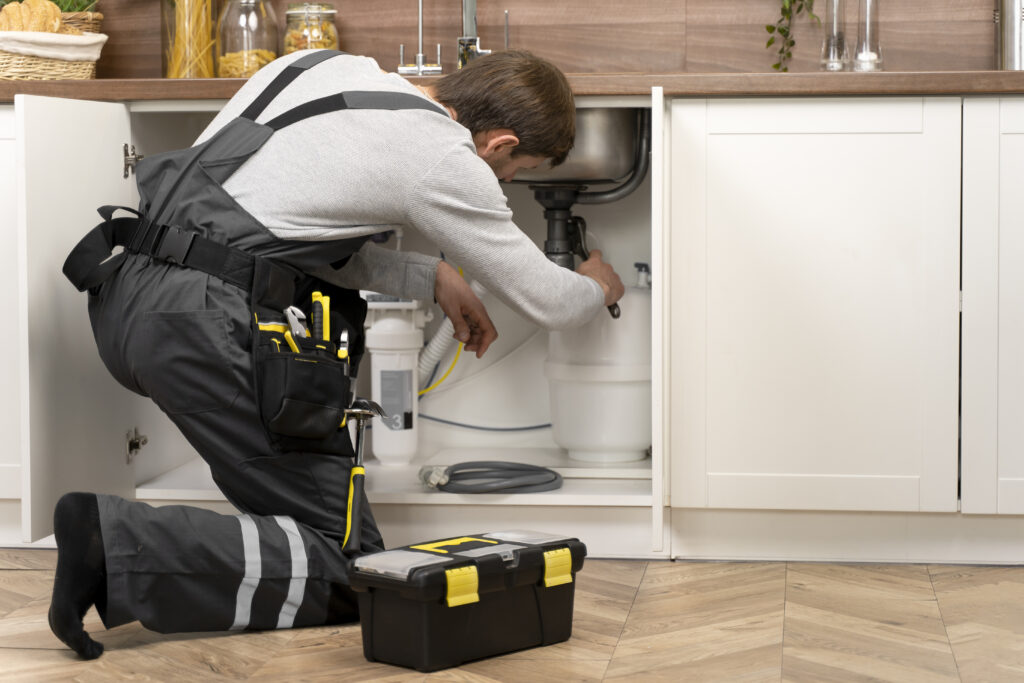
Include photos of branded trucks and vans, licensed plumbers in uniform, before-and-after shots of completed jobs, equipment and tools, and team photos. Profiles with robust photo libraries consistently earn higher engagement than those with minimal or stock imagery.
Web Design & Development for Plumbers: Built for the Emergency Moment
A plumbing website has one primary job: get the visitor to call. The design, the content, the conversion architecture – all of it needs to be engineered around the reality that many visitors are under stress, on a mobile device, and making a decision in under 60 seconds.
Explore our plumbing web design & development services
The Above-the-Fold Experience
The most important real estate on your entire website is what a visitor sees before scrolling on a mobile phone. That space needs: your phone number (large, tap-to-call), a clear statement of what you do and where, your key trust signals (licensed, insured, 24/7 available, years in business), and a clear call-to-action. If a stressed homeowner cannot find your phone number within 3 seconds, you have lost them.
Trust Architecture
Your website needs to proactively address trust concerns:
- Are plumbers background-checked?
- Are you licensed and insured (with your license number visible)?
- How long have you been in business?
- Do you provide upfront pricing?
These are the questions running through a homeowner’s head as they decide whether to call you. Answering them on your home page directly improves conversion rates.
Location Pages for Multi-Area Coverage
If you serve multiple cities, location-specific pages are essential. A homeowner searching ‘plumber in Clearwater’ will not be served by a page that mentions Clearwater once in passing. Each location page should include specific information about your service history in that area and content unique to that city – not just a template with the city name swapped.
Check out our plumbing web design & development service.
Paid Advertising (PPC) for Plumbers
Paid search for plumbing companies is powerful and expensive in equal measure. Plumbing is consistently one of the highest-CPC categories in local services, with clicks for emergency terms in competitive markets sometimes exceeding $30 to $50. The upside is equally significant — a single water heater replacement or whole-house repipe can generate thousands in revenue from a single lead.
Google Search Ads: Structuring for Plumbing Intent
A well-structured plumbing Google Ads campaign separates emergency intent from planned service intent — because the bids, ad copy, and landing pages are fundamentally different. Emergency campaigns target terms like “emergency plumber near me” and “burst pipe repair” with maximum bids and single-goal landing pages (call now). Planned service campaigns target terms like “water heater installation” and “drain cleaning service” with ad copy emphasizing quality and value over urgency.
Negative keyword management is critical. You need to exclude “DIY plumbing,” “plumbing supplies,” “plumbing school,” and “plumbing jobs” along with hundreds of other irrelevant terms that drain your budget without generating qualified leads.
Dayparting and Geographic Bidding
Plumbing calls spike in the morning (when people discover problems before leaving for work), on weekends, and during weather events. Bid scheduling — raising bids during high-conversion windows and reducing them during slow periods — improves your cost per lead. Geographic bid adjustments let you invest more aggressively in your highest-value service areas.
Seasonal PPC Strategy for Plumbers
Winter brings emergency calls for frozen and burst pipes. Spring brings planned projects funded by tax refunds. Summer is heavy for outdoor plumbing and renovation work. Fall brings pre-winter maintenance. A seasonal strategy adjusts messaging and budget to match these demand shifts — promoting winterization in fall, water heater tune-ups in winter, and renovation capabilities in spring and summer.
Google Local Services Ads: The Emergency Plumber’s Best Friend
Google Local Services Ads appear at the very top of search results — above both Google Ads and organic listings — with a “Google Verified” badge, your review count, and your phone number.
For emergency plumbing searches, where the decision happens in seconds and trust is the primary factor, that badge is a powerful differentiator. LSAs charge per lead rather than per click, making them highly efficient when managed properly.
Quote Request Form Optimization
Not every plumbing customer wants to call — particularly for non-emergency, planned service work. A multi-step quote form works best:
- Step 1 asks what service is needed
- Step 2 asks for details about the issue
- Step 3 asks for contact information
Multi-step forms consistently outperform single long forms because once someone completes step 1, they’re much more likely to complete step 3.
Speed to Lead for Plumbing
Emergency plumbing leads have an extremely short window. A homeowner searching at 8 AM on Monday is probably already calling two other companies. For form submissions, automated immediate confirmation via text or email — followed by a live call within 5 to 10 minutes — dramatically improves your conversion rate.
CRM tools like Jobber, ServiceTitan, or HouseCall Pro can automate much of this process. SEO For Home Service also offers a free CRM with our plumber digital marketing services that handles this automation.
Retargeting: Capturing Planned Service Researchers
Emergency customers rarely need retargeting — they’re calling someone right now. But planned service customers will visit your website, look at competitors, and then think about it.
Retargeting ads on Google Display and Meta keep your company top of mind during the consideration period. For higher-ticket planned work, retargeting meaningfully improves conversion at relatively low cost.
Reputation Management for Plumbers
Plumbing is one of the highest-trust home service categories. You’re inviting a stranger into someone’s home, often during a stressful situation, and accessing critical systems. Reviews are the mechanism by which prospective customers evaluate that trust before opening the door.
A plumbing company with 4.8 stars and 300 Google reviews will win the call over a company with 4.2 stars and 25 reviews almost every time — regardless of ranking position.
Post-Job Review Generation
The best time to ask for a review is immediately after a successful service call, while the customer’s relief and gratitude are at their peak. Train technicians to ask verbally at the end of every job: “We really appreciate your business. If we did a great job today, we’d love it if you took a minute to leave us a Google review.” Follow with an automated text containing a direct link to your Google review page — sent within an hour of job completion.
You can entice your technicians to ask for reviews by holding in-office rewards for the most reviews, such as:
- A gift card
- A paid four-day weekend
- A monthly bonus
Handling Negative Reviews
Plumbing generates more negative reviews than most home services because customers are already stressed when they call, and prices can feel high when something goes wrong unexpectedly.
Respond to all negative reviews within 24 hours, acknowledge the customer’s experience specifically, offer to make it right with direct contact information, and keep your tone professional regardless of how unfair the review seems. A well-handled negative review often builds more trust than it costs.
Review Platform Strategy
Google reviews are the primary driver of Map Pack performance. But Yelp, Angi, HomeAdvisor, the BBB, and Nextdoor all contribute to your overall online reputation and appear in searches for your company name. Prioritize Google, then Yelp, then the others — but don’t neglect any platform where your customers are already leaving reviews.
Seasonal and Event-Driven Marketing for Plumbers
Plumbing demand is both seasonal and event-driven. A proactive plumber digital marketing strategy anticipates spikes rather than reacting to them.
- Winter: Frozen and burst pipes drive emergency call volume — start winterization campaigns in September and October before the first freeze warning
- Spring: Planned projects funded by tax refunds — promote water heater replacements, bathroom remodels, and whole-house inspections
- Summer: Renovation season — heavy for outdoor plumbing, irrigation, and remodeling work
- Fall: Pre-winter maintenance wave — promote system inspections and checks before the first freeze
Holiday timing matters too. Thanksgiving is one of the busiest days for emergency plumbing calls — garbage disposal failures and drain backups from heavy cooking are predictably common. Being visible and available on those days is a direct competitive advantage.
Analytics and Tracking: Measuring What Matters
For a plumbing company, the only digital marketing metrics that ultimately matter are calls, service requests, and booked jobs. Call tracking is the single most important analytics tool — knowing which marketing channel generated each call is essential for intelligent budget allocation. Without it, you’re flying blind.
The core analytics stack: Google Analytics 4 for website behavior; Google Search Console for organic keyword performance; call tracking software with dynamic number insertion; and a field service management CRM (Jobber, ServiceTitan, or HouseCall Pro) that connects marketing leads to completed jobs and revenue.
Monthly metrics to review: total calls by channel, cost per call by channel, call-to-booked-job conversion rate, average job value by service type, and organic keyword ranking movement.

Getting Started: Your Plumber Digital Marketing Roadmap
The order of operations matters. Trying to do everything at once spreads resources too thin and delays results.
Phase 1 — Foundation (30–60 days): A properly built website, complete and optimized GBP, consistent citations across major directories, and Google Analytics and call tracking set up correctly.
Phase 2 — Organic Presence (months 2–6): On-page SEO for core service and location pages, a content publishing cadence targeting both emergency and planned service keywords, and the beginning of a link-building program. Organic results take 3 to 6 months to materialize.
Phase 3 — Paid Advertising: Google Local Services Ads first, then Google Search Ads for high-intent service terms, then retargeting for planned-service researchers who didn’t convert.
Phase 4 — Long-Term Systems: Systematic post-job review generation. This is the channel that compounds most powerfully over time — every review makes the next conversion easier and reduces your cost per lead across every other channel.
Frequently Asked Questions
Google Local Services Ads and Google Search Ads can generate calls within days of launching. GBP optimization improvements typically show results within 30 to 60 days. SEO for organic search takes 3 to 6 months for meaningful movement on competitive terms, with results accelerating as domain authority builds over 12 to 18 months of consistent effort.
Industry benchmarks suggest 5 to 10% of revenue for service businesses in competitive markets. For a company doing $750,000 in annual revenue, that's roughly $3,000 to $6,000 per month. Companies in major metro areas will typically need to invest at the higher end — particularly in paid advertising.
Google Business Profile optimization. It's free, it directly affects Map Pack rankings and emergency call volume, and most plumbing companies have significant optimization opportunities available. A fully optimized GBP with consistent review generation can transform local visibility within 60 to 90 days — faster than any other channel.
Purchased leads can supplement your organic lead flow, but they're rarely a long-term strategy. The leads are expensive, shared with multiple competitors, and often lower quality than leads generated through your own digital presence.
Use aggregators as a short-term bridge while you're building your own lead generation engine — then reduce dependence on them as your organic rankings and direct leads grow.
Yes, if you want to rank in local searches across your entire service area. A city-specific page for “plumber in St. Petersburg” will consistently outrank a generic page that mentions St. Petersburg in passing. Location pages need genuine, unique content — not templated pages with only the city name changed.
With local specificity and review volume. National franchises can't out-local you. Hyper-specific service area pages, deep community presence, a higher volume of genuinely local reviews mentioning specific neighborhoods, and a website that communicates genuine local roots will outperform a franchise's generic local presence in many markets. Local SEO rewards authenticity — an advantage that belongs to you, not the franchise.