
If there’s one thing you take from this entire guide, let it be this: The Map Pack is the most valuable real estate in local search.
When a homeowner searches for a service provider, Google typically shows three local businesses at the top of results — above the organic listings, above the ads in many cases. This is the Map Pack (also called the Local Pack or 3-Pack).
For home service businesses, appearing in the Map Pack isn’t optional. It’s where the majority of clicks happen. Studies show that 42% of local searchers click on the Map Pack results. If you’re not in those three spots, you’re splitting the remaining clicks with every other result on the page.
How to Rank in the Map Pack
Map Pack rankings are driven primarily by three factors:
- Relevance — Does your Google Business Profile accurately describe what you do? Are your categories, services, and business description aligned with what people are searching for?
- Distance — How close is your business to the person searching? You can’t control this, but you can expand your effective radius through smart optimization.
- Prominence — How well-known and trusted is your business? This is where reviews, citations, backlinks, and overall online authority come into play.
Optimizing for these factors is the foundation of local SEO for home services. It starts with your Google Business Profile.
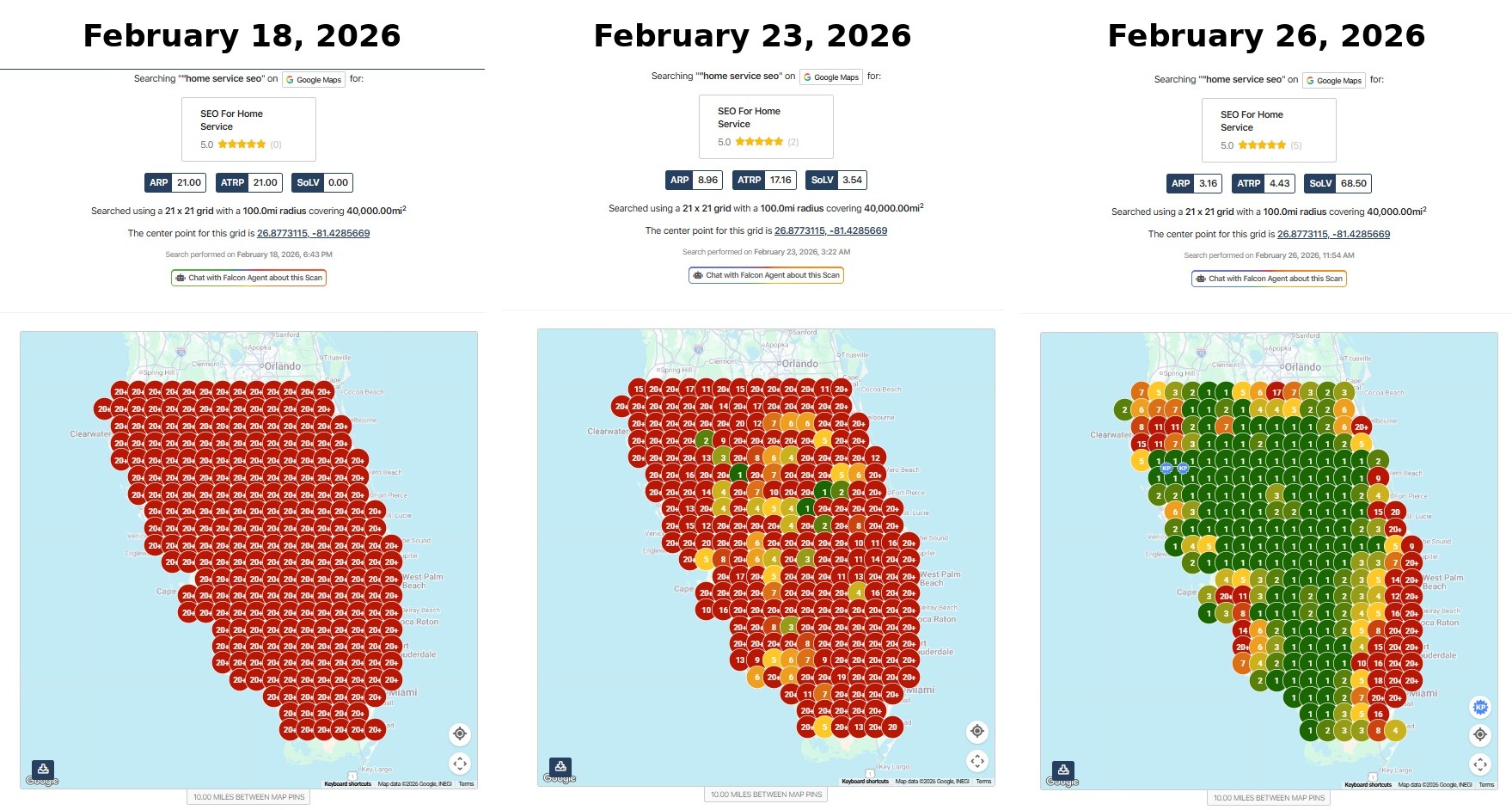
See How We Ranked Our Agency in the Map Pack Across All of Florida
During a 10–day local optimization sprint to take advantage of our own backyard, we earned No. 1 Map Pack rankings across the entire state of Florida for our main keyword, taking our share of local voice (SoLV) from 0% to 68.5% – nearly 6 times the SoLV of our nearest competitor.
This is what a focused local optimization strategy looks like in practice — and the same principles apply to any market in the country.
 Your Google Business Profile (GBP) is the single most important asset in your local SEO strategy. It feeds the Map Pack, powers your Knowledge Panel, and often serves as the first impression a homeowner has of your business.
Yet most contractors set up their profile once and never touch it again. That’s a mistake.
Complete Every Field
Google rewards completeness. Fill out every available field in your profile:
- Business name: Your actual business name, no keyword stuffing
- Primary and secondary categories: Choose the most specific category first (e.g., “Plumber,” not “Home Services”)
- Service area: define every ZIP code or city you serve
- Hours of operation: Keep these accurate and update for holidays
- Phone number: Use a local number, not a tracking number as your primary
- Website URL: Link to your homepage or a dedicated landing page
- Business description: 750 characters to describe what you do, who you serve, and what sets you apart
- Services: List every service with descriptions very matter-of-factly, as Google often deprioritizes salsely service descriptions
- Products: Use this section to showcase specific service packages
Reviews Are Your Ranking Fuel
Reviews are one of the strongest ranking signals for the Map Pack. More importantly, they’re what convince a homeowner to call you instead of the next company.
Volume Matters
The more reviews you have, the more prominently Google features your business. Don’t be shy about asking every satisfied customer.
Recency Matters
A burst of reviews from three years ago tells Google less than a steady stream of recent ones. Build a system for consistently requesting reviews after every job.
Response Matters
Reply to every review — positive and negative. Google tracks response rates, and homeowners read your replies. A professional response to a negative review can actually build more trust than a perfect score because no one can satisfy every customer, and potential buyers appreciate this and your attempt to rectify any issues professionally.
Keywords in Reviews Matter
When customers naturally mention services (“great AC installation,” “fixed our roof fast”), it reinforces your relevance for those terms. Don’t coach customers on what to say, but don’t be surprised when specific service mentions help your rankings.
At SEO For Home Service, all of our packages include our state-of-the-art ServiceCommand CRM™, which automatically contacts clients for reviews, automatically replies to reviews, and flags negative reviews for your attention before they become a problem.
Post Regularly
Google Business Profile posts are an underused feature. Posting weekly updates, offers, project photos, and tips signals to Google that your business is active and engaged. It also gives homeowners another reason to choose you.
 Your website is your digital storefront. For SEO to work, every page needs to be built with purpose — targeting specific keywords, answering specific questions, and guiding visitors toward picking up the phone.
Service Pages: Your Bread and Butter
Every service you offer deserves its own dedicated page. Not a bullet point on a “Services” page — a full, optimized page.
“Plumbing Services” is not a keyword strategy. “Water heater installation,” “sewer line repair,” “drain cleaning,” and “emergency plumber” are. Each of these represents a different homeowner, a different problem, and a different level of urgency. Each needs its own page.
A strong service page includes:
- A clear H1 targeting the primary keyword
- 800-1,500+ words of genuinely helpful content about the service
- What the service includes, how it works, what to expect
- Pricing transparency (even ranges help)
- Trust signals — licenses, certifications, insurance, warranties
- A clear call to action — phone number, form, or both
- Schema markup — Service schema tied to your LocalBusiness entity
For example, if you’re an HVAC company, you don’t just need one page — you need dedicated pages for emergency heater repair, emergency air-conditioner repair, furnace tune-ups, and air-conditioner winterization, each targeting distinct search intents.
Location Pages: Expanding Your Reach
If you serve multiple cities or neighborhoods, create a separate page for each. This is how local SEO for home service companies scales beyond a single city.
A good location page isn’t just your service page with the city name swapped in. It should include:
- Unique content about serving that specific area
- References to local landmarks, neighborhoods, or common issues in that region
- Embedded Google Map of the service area
- NAP (Name, Address, Phone) information
- Reviews or testimonials from customers in that area
Warning: Thin, duplicate location pages will hurt you. If you can’t write genuinely unique content for a location, don’t create the page. Google is sophisticated enough to recognize templated garbage, and it will penalize you for it. This is where a skilled home service SEO expert takes your site to a new level without damaging your rankings – we understand this nuance.
Blog Content: Building Topical Authority
Your blog isn’t a diary — it’s a lead generation tool. Every post should target a keyword that homeowners are actively searching for. This applies whether you’re focused on traditional home improvement SEO services like HVAC and plumbing, home builder SEO services, or any other trade — the content strategy is the same.
The best SEO marketing for home service companies includes content that answers the questions homeowners ask before they call, such as:
- “How much does a new AC unit cost?”
- “Signs your roof needs to be replaced.”
- “How often should you service your HVAC system?”
- “Is a tankless water heater worth it?”
These informational searches build topical authority — they tell Google that your website is a comprehensive resource on your trade. That authority lifts all your pages, including the service pages that generate calls.
 Every home service trade has unique search patterns, seasonal trends, and customer behaviors. A one-size-fits-all approach doesn’t cut it. Here’s how SEO differs across the major trades:
- Plumbing — Heavy emergency search volume (“burst pipe,” “clogged drain”). Plumbing SEO requires fast-loading pages with prominent phone numbers, because these searchers need help now — not in an hour. Plumbing lead generation thrives on urgency.
- HVAC — Highly seasonal in most areas with massive spikes in summer and winter. HVAC SEO services should include content targeting both emergency repairs and planned installations, with seasonal content published ahead of demand curves.
- Electrical — Mix of emergency and planned work. Electrician SEO benefits from content on safety, code compliance, and home upgrades such as EV charger installation and panel upgrades. Electrician lead generation converts well because homeowners rarely comparison-shop for electrical work.
- Roofing — Storm-driven demand creates massive spikes. Roofing SEO should include storm damage content that can be quickly promoted when severe weather hits your market. Roofing lead generation is among the highest-value in the trades.
- Landscaping — Seasonal but predictable. Landscaping SEO benefits from visual content — before-and-after galleries, project showcases — that also serve as link-worthy content for building authority. Local SEO for landscaping companies is especially important since services are inherently location-bound.
- Pest Control — Seasonal with geographic variation. Pest control SEO should target pest-specific keywords (“termite treatment,” “bed bug removal”) because homeowners search for the problem, not the service category.
- Moving Companies — High competition, high CPC in paid search. Moving company SEO provides a critical cost advantage over PPC in this space, where organic rankings can save thousands per month in ad spend.
- Home Cleaning — Recurring service model means lifetime customer value is high. Home cleaning SEO should emphasize trust signals and reviews, since homeowners are letting strangers into their homes.
- Remodeling & Construction — Longer sales cycles, higher project values. Construction lead generation requires content that educates throughout the decision process — cost guides, project timelines, and portfolio showcases.
- Junk Removal — Impulse-driven searches with high conversion rates. Junk removal SEO benefits from simple, fast pages with clear pricing and immediate booking options.
- Lawn Care — Overlaps with landscaping but targets maintenance over installation. Lawn care SEO should focus on recurring service keywords and seasonal programs.

 Not all SEO providers are built the same, and the home service industry has been burned by more bad agencies than almost any other vertical. Choosing the right home service SEO agency can be the difference between a pipeline full of booked jobs and a wasted marketing budget. Here’s how to evaluate whether an SEO company actually knows what they’re doing.
Red Flags
- Guaranteed rankings: No one can guarantee a #1 position. Google’s algorithm considers hundreds of factors, and anyone making promises is either lying or manipulating the system in ways that will eventually get you penalized.
- No transparency: If an agency won’t show you exactly what they’re doing each month, they’re probably not doing much.
- One-size-fits-all packages: A plumber in Lakeland and an HVAC company in Phoenix have completely different competitive landscapes. Cookie-cutter strategies produce cookie-cutter results.
- No industry specialization: General agencies don’t understand the nuances of home service marketing — the seasonality, the emergency search behavior, the trust factors that matter to homeowners.
- Long-term contracts with no performance metrics: If an agency needs to lock you into a 12-month contract to keep you, it’s because they know you’d leave if you could.
Green Flags
- Industry-specific experience: An SEO company that specializes in home service contractors understands your business model, your customers, and your competitive landscape.
- Transparent reporting: Monthly reports showing rankings, traffic, leads, revenue, ROI, and the specific work performed. No vanity metrics — real numbers tied to real business outcomes.
- Customized strategy: Your SEO plan should be built around your services, market, and goals. Check out our transparent service & pricing tiers to see what a structured, trade-specific approach looks like.
- Technical competence: They should be able to audit your site, explain the issues, and articulate a clear plan to fix them — in language you can understand.
- Proof of success: Ask for case studies or references from businesses in the home service space. Results speak louder than sales pitches. The best SEO agencies for home services contractors will have a portfolio of wins they can point to — not just rankings, but actual leads and revenue growth. If you’re considering a younger home service SEO provider with limited client references, ask to see their organic growth to gauge their SEO skills.
 This isn’t an either/or conversation — it’s a sequencing question.
PPC (Pay-Per-Click) gets you immediate visibility. You can launch a Google Ads campaign today and start getting calls tomorrow. But you’re paying for every click, and the moment you stop paying, the leads stop.
SEO takes longer to produce results — typically 3-6 months for meaningful and consistent traction. But the leads it generates are essentially free once you’ve earned the rankings. And unlike PPC, the value compounds over time.
The smart approach: Use PPC to generate leads while your SEO strategy builds momentum. As organic rankings climb, you can strategically reduce ad spend on keywords where you’re already ranking well. Eventually, SEO becomes your primary lead source, and PPC fills in the gaps, such as seasonal pushes, new service launches, or competitive keywords where you haven’t cracked the top three yet.
For home service businesses specifically, Local Services Ads (LSAs) are another channel worth considering. These Google Verified ads appear at the very top of search results and operate on a pay-per-lead model rather than a pay-per-click model. They’re particularly effective for emergency services, such as plumbing, HVAC, and electrical work.
Wondering whether to handle SEO in-house or hire an agency? That decision depends on your budget, bandwidth, and the speed at which you need results.
 Let’s talk about what actually matters: leads and revenue. Not rankings, not traffic, not impressions — calls from homeowners who need your services and are ready to book.
Here’s a realistic timeline of what to expect when you invest in a proper home service SEO strategy.
Month 1-2: Map Pack Visibility and Early Leads
This is where results come fastest. A fully optimized Google Business Profile starts gaining traction quickly — improved category targeting, complete service listings, a steady review strategy, and consistent posting can push you into the Map Pack within weeks.
Because the Map Pack appears above organic results for most local service searches, this is often where your first SEO-driven leads come from.
Don’t be surprised if the phone starts ringing from map visibility before your website rankings move. During this phase, your SEO team should also complete your technical audit, fix site issues, build out your keyword strategy, and begin on-page optimization. The organic groundwork is being laid — you just won’t see it in Google yet.
Month 3-4: Organic Leads Start Trickling In
This is the inflection point. Google begins testing your new and optimized content in search results — pushing pages up, pulling them back, seeing how users respond.
You’ll notice pages appearing in positions 8-15 for target keywords, sometimes jumping into the top 5 briefly before settling. The leads from organic search start as a trickle during this window.
You might get one or two calls a week that didn’t come from the Map Pack or paid ads — these are homeowners finding your service pages directly through Google search. It’s not a flood yet, but it’s proof that the strategy is working.
Meanwhile, your Map Pack leads should be growing steadily as your GBP authority strengthens and your review count climbs.
Month 5-6: Momentum Builds, Lead Volume Grows
Rankings stabilize and start climbing into the top 10 for more keywords. The pages Google was testing in months 3-4 are now settling into stronger positions, and new content is entering the index and ranking faster as your site’s topical authority builds. Lead volume from organic search typically doubles or triples compared to months 3-4.
You’re now getting consistent calls from both the Map Pack and organic listings. Homeowners are finding you through multiple search queries — not just your core services, but related terms, long-tail questions, and “near me” variations.
Your cost per lead drops significantly because these leads cost nothing beyond your monthly SEO investment.
Month 7-9: Compounding Growth
This is where home service SEO starts outperforming every other marketing channel.
Rankings are now established across multiple keywords. Your content library is generating traffic from dozens or hundreds of search terms you never directly targeted — that’s topical authority at work.
Lead flow becomes predictable. You can start forecasting monthly call volume based on search trends and seasonal patterns. Map Pack visibility is strong and expanding into adjacent ZIP codes as your prominence signals grow.
At this stage, many contractors begin reducing their PPC spend because organic is delivering equal or greater lead volume at a fraction of the cost.
Month 10-12: Market Dominance
Your website is now a lead generation machine.
Top-3 rankings across your primary keywords mean you’re one of the first companies homeowners see in both organic results and the Map Pack. Lead volume is consistent, high-quality, and sustainable. The investment shifts from building to maintaining and expanding — new service pages, new market areas, new content targeting seasonal opportunities.
At this point, your competitors are now chasing you instead of the other way around.
Beyond 12 Months: SEO Becomes Your Most Profitable Channel
The math gets better every month. Your SEO investment remains relatively flat while lead volume continues to grow as content ages, authority compounds, and rankings strengthen.
The leads you’re generating from SEO have zero marginal cost — every additional call is pure profit compared to PPC, where every click has a price tag.
At this point, SEO isn’t a line item on your marketing budget — it’s the foundation your entire growth strategy is built on.
The key metric through every phase isn’t rankings — it’s revenue. A legitimate home service SEO strategy should produce a measurable return on investment within 6-9 months, with ROI improving each month thereafter.
This is not to say there is no revenue in early months — there absolutely is from Map Pack placements and leads during the testing phase. However, months 6-9 are when the volume becomes consistent and predictable enough to build your business around.